
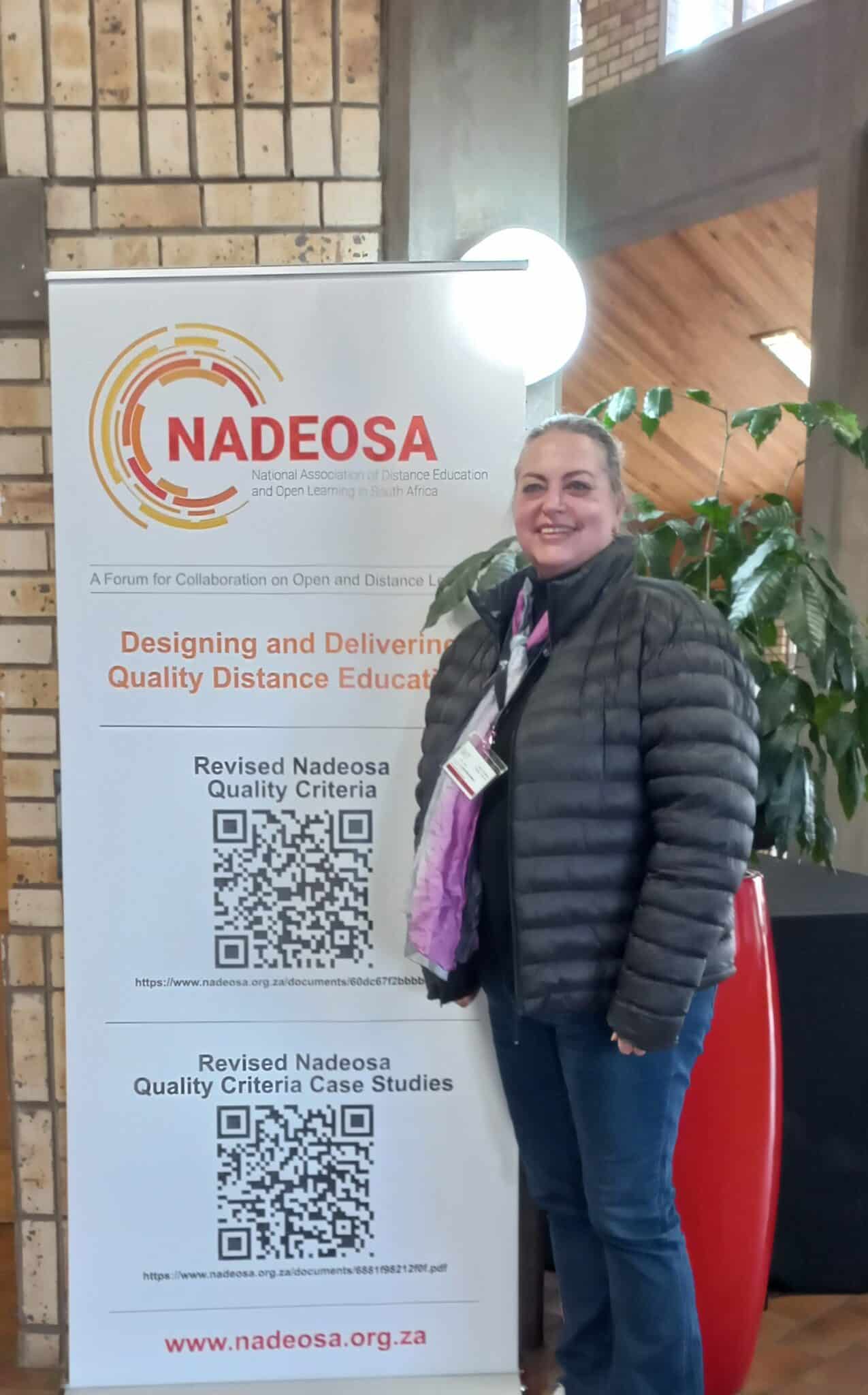
NADEOSA’s Future Directions of Quality Open and Flexible Learning in the Global South Conference


The National Association of Distance Education and Open Learning in South Africa (NADEOSA) Future Directions of Quality Open and Flexible Learning in the Global South conference provided valuable insights into the rapidly changing higher education landscape, particularly regarding artificial intelligence, assessment integrity, student support and quality assurance in open and flexible learning environments.
A central theme across the conference was that the challenges currently faced by higher education institutions are not isolated to individual institutions but form part of a broader global and regional shift in teaching, learning and assessment practices.
Addressing AI Integrity and Institutional Frameworks
One of the most prominent discussions focused on the use and misuse of artificial intelligence in assessments. It was widely acknowledged that many higher education institutions are grappling with the unethical use of AI by students and that this is not unique to any one institution.
However, the discussion also shifted responsibility back to academics and assessment designers. A strong view expressed during the conference was that if an assessment question can be answered effectively by AI without requiring meaningful student engagement, application or critical thought, then the issue may lie not only with the student, but also with the design of the assessment itself.
This emphasises the urgent need for more authentic, applied and process-based assessment practices.
Linked to this was the broader discussion around institutional responses to AI. Presenters generally agreed that higher education institutions should be cautious about developing formal AI policies too quickly, as policy development is often slow, while AI technologies continue to change rapidly.
Instead, institutions may benefit more from flexible frameworks or guidelines that focus on the ethical, responsible and academically meaningful use of AI. There was also considerable debate about what constitutes ethical use, where the boundaries should be drawn and how students and academics can be guided to make responsible decisions.
The UNESCO AI Competency Framework for Students was highlighted as a useful reference point in this regard. The framework identifies 12 competencies across four dimensions: a human-centred mindset, the ethics of AI, AI techniques and applications, and AI system design. These competencies are developed across three levels of progression, namely understanding, applying and creating. Such a framework can support students in developing the knowledge, skills and values required to engage with AI responsibly and critically.
A recurring concern was that if students continue to rely on AI unethically, higher education risks producing what one might call ‘plastic degrees’, qualifications that appear valid on paper but do not reflect genuine competence. Another powerful metaphor used was that of giving students a ‘toolbox with no tools in it’. This captures the danger of students obtaining credentials without developing the necessary knowledge, skills, judgement and academic confidence required in practice.
Transforming Learning Delivery and Content Engagement
At the same time, the conference did not position AI only as a threat.
There were also constructive discussions about how AI could be used to support student learning. One suggestion was to develop an AI- or ChatGPT-based tutor bot that could guide students through learning materials, answer basic questions, provide additional examples and support independent study. Such tools could be particularly valuable in online and distance learning contexts, provided they are designed to supplement meaningful academic engagement, rather than replace it.
The changing ways in which students engage with learning material were also discussed. Although lecturers may record online sessions, students often engage with only a small portion of the recording, sometimes as little as six minutes on average. Students may then use AI tools to generate transcripts, smart charts or summaries from the recordings.
This raises important questions about how learning materials are designed, how students engage with content and how institutions can encourage deeper and more active learning.
Shifting Educational Taxonomies and the Role of Human Care
Another important discussion centred on the need to rethink traditional taxonomies of learning. There is growing interest in moving beyond outcome-based interpretations of Bloom’s Taxonomy towards more process-orientated, learning-centred approaches. These emerging taxonomies emphasise activities such as retrieving and validating, interpreting and refining, adapting and implementing, critiquing and deconstructing, and co-creating and innovating.
This shift is particularly relevant in an AI-rich learning environment, where students need to demonstrate not only what they know but how they think, evaluate, adapt and create.
Despite the focus on technology, a strong message throughout the conference was that human connection remains essential. Presenters agreed that students still require ‘human care’ in their learning journeys. This is particularly important for online cohorts, where students may already feel isolated from the institution and their peers.
One presenter captured this sentiment by stating that “it’s all about the love”. In other words, even in an AI-enabled educational environment, students still want to feel seen, supported and connected to real people.
Developing Academic Literacy and Managing Digital Inequality
The conference also raised the question of what students require in the age of AI. One important point was that students need to ‘learn how to learn’ in an AI environment.
When students feel overwhelmed, for example, when they face several assessments at once, there may be a greater incentive to misuse AI. This places responsibility on institutions to consider assessment load, student support and academic literacy development. A clear distinction was also made between digital literacy and academic literacy. Digital literacy may involve access to and basic use of AI tools. In contrast, academic literacy involves knowing how to use such tools critically, ethically and in support of one’s own argument.
AI and inequality also emerged as a significant concern. Several presenters argued that AI may deepen existing inequalities in higher education.
In the Global South, the high cost of data remains a barrier for many students. In addition, students from higher-income households may be able to afford premium AI tools with more advanced features, while lower-income students may be limited to free versions. If paid tools provide stronger or more accurate responses, this could create further disparities in academic performance and learning opportunities.
Innovative Assessment Design and Evolving Regulatory Standards
A practical assessment idea shared during the conference involved using discussion forums more creatively. For example, students could be asked to formulate a question for their peers, after which another student responds to it. A week later, the student who created the original question would then post the answer.
This type of activity encourages students to think critically, engage with content from multiple perspectives and take responsibility for both questioning and answering.
The conference also highlighted developments in quality assurance and delivery modes. The Council on Higher Education is reportedly in the process of reconsidering how modes of delivery are classified. The emerging approach focuses on three core elements: time, space and pace.
Time refers to whether learning is synchronous or asynchronous, space refers to where learning takes place, and pace refers to how learning progresses. This reclassification has important implications for the provision of open, distance, online and flexible learning.
Conclusion: Shaping the Future of Flexible Education
Overall, the conference reinforced the need for higher education institutions to respond thoughtfully and proactively to the opportunities and risks presented by AI.
Students should be encouraged to learn with AI, but not become dependent on it.
The future of quality, open and flexible learning will require ethical use of AI, stronger assessment design, renewed attention to academic literacy and continued commitment to human-centred student support.
Frequently Asked Questions: Future Directions of Quality Open and Flexible Learning
1. What is the danger of “plastic degrees” in the age of artificial intelligence?
The term “plastic degrees” describes a significant risk in higher education where qualifications appear valid on paper but do not reflect genuine student competence. This happens when students rely unethically on artificial intelligence to pass assessments, resulting in a “toolbox with no tools in it” where graduates lack the necessary knowledge, critical judgement, and academic confidence required in professional practice.
2. How should assessment design adapt to the widespread availability of AI tools?
Conference discussions emphasised that if an assessment question can be answered effectively by AI without requiring meaningful student engagement, the issue lies within the design of the assessment itself. Higher education institutions must transition towards more authentic, applied, and process-based evaluation models. This includes shifting from traditional output-based testing to modern educational taxonomies that measure how students retrieve, validate, critique, deconstruct, and co-create information.
3. How does digital inequality impact students using AI in the Global South?
Artificial intelligence threatens to deepen existing inequalities in the Global South due to the high cost of data and financial disparities. Affluent students can often afford premium AI tools that feature advanced capabilities and higher accuracy, whilst lower-income students remain limited to free, less sophisticated versions. This creates further disparities in academic performance and learning opportunities across different socio-economic groups.
4. How does the IMM Graduate School respond to the fast-changing AI landscape?
In line with the recommendations from the NADEOSA conference, the IMM Graduate School focuses on creating flexible frameworks and guidelines rather than rushing into rigid formal policies that quickly become outdated. By utilizing references like the UNESCO AI Competency Framework, the institution guides both academics and students towards the ethical, responsible, and academically meaningful integration of technology in distance learning.
5. How does the IMM Graduate School ensure human-centred support for online cohorts?
Despite the rapid integration of educational technology, the IMM Graduate School prioritises “human care” to combat the isolation often felt by online and distance-learning cohorts. Represented at the conference by academics such as Karlien Stemmet (Head Lecturer in Economics), the institution structures its learning delivery to ensure that students feel seen, supported, and connected to real educators throughout their academic journeys.
6. What practical steps is the IMM Graduate School taking to improve student academic literacy?
The IMM Graduate School addresses student assessment load and support systems to reduce the incentive for AI misuse. Faculty members focus on developing true academic literacy—teaching students how to use digital tools critically and ethically to support their own original arguments—whilst redesigning course delivery to encourage deeper, active engagement with online materials and peer-to-peer learning forums.