
Key Insights from the 19th International eLearning Africa Conference


The 19th International eLearning Africa Conference brought together educators, researchers, and technology leaders from across the globe to address the rapidly evolving landscape of digital education. With the swift rise of Generative AI (GenAI) reshaping traditional academic frameworks, the event served as a critical platform for discussing how institutions can balance technological innovation with academic integrity, material equity, and cultural sovereignty.
From redefining assessment strategies in distance learning to establishing localised ethical frameworks rooted in African philosophy, the conference highlighted essential strategic insights for higher education leaders. Below are the key takeaways, comparative institutional approaches, and foundational pillars discussed during this landmark event.
Pedagogical Shifts: Academic Integrity and Assessment Redesign
The rapid proliferation of GenAI tools has necessitated a fundamental reassessment of how student learning is evaluated, moving institutions away from traditional, recall-based summative assessments.
Moving Beyond Punitive Integrity Measures
Research presented by Dr Aletta Mweneni Hautemo (associate professor for digital linguistics and literature in the Faculty of Commerce, Human Sciences and Education at the Namibia University of Science and Technology in Windhoek, Namibia) highlighted a persistent gap between stakeholders’ awareness of academic integrity and its practical implementation within Namibian open learning institutions. Because physical supervision is absent in online environments, the temptation to utilise unauthorised AI assistance remains high.
Dr Hautemo argued that relying solely on punitive measures or AI-detection software is insufficient. Instead, institutions must transition towards authentic assessments that evaluate higher-order critical thinking. Fostering robust instructor-student relationships and designing assessments that require contextualised, original thought are critical to mitigating academic dishonesty.
The ‘Usage Versus Impact Paradox’ in Distance Learning
Addressing the vulnerability of traditional essays, Riana Prins and Brad Bell (IMM Graduate School, South Africa) analysed how undergraduate distance learners engage with AI-resistant assessment methods. Their research revealed a distinct ‘Usage Versus Impact Paradox’: whilst students heavily utilise general online content and module materials, mere access to these resources does not correlate with overall learner satisfaction.
Instead, the study identified meaningful peer discussion as the primary driver of assessment satisfaction. To combat the isolation of distance learning and the rise of AI-generated submissions, the presenters urged institutions to:
- Incorporate process-orientated portfolios (e-portfolios).
- Utilise collaborative oral tasks.
- Intentionally ‘engineer social contact’ by embedding facilitated online forums and peer-review cycles directly into assessment rubrics.
Equity, Sovereignty and the Ubuntu Ethical Framework
A major theme of the conference was the tension between technological advancement and resource constraints, prompting calls for localised, ethical approaches to AI adoption.
Navigating the Resource-Equity Paradox
Prof. Karen Ferreira-Meyers (a distinguished expert in blended and e-learning, with over two decades of experience transforming distance education in Southern Africa, based at the University of Eswatini’s Institute of Distance Education (IDE)) examined the deployment of GenAI within small, landlocked higher education systems. While GenAI offers substantial opportunities – such as 24/7 personalised tutoring, drafting assistance and crucial language translation for siSwati-first learners – it also presents an equity paradox.
If access to these tools is restricted to affluent students who already possess reliable internet data, modern devices and English fluency, GenAI will inevitably widen the digital divide. Prof. Ferreira-Meyers advocated for a ‘sovereignty-first approach’ characterised by:
- Formulating institutional policies that enable, rather than ban, AI usage.
- Systematically building digital and AI literacy amongst staff and students.
- Deliberately subsidising internet data to support rural and marginalised learners.
The A2E2 Ubuntu Framework for African AI Ethics
Representing the Afretec Network, Dr Thomas Fox McManus (Carnegie Mellon University Africa) introduced the A2E2 Ubuntu Framework, which seeks to de-centre Western-centric ethical models in favour of indigenous African philosophy. Guided by the principle of Ubuntu (“I am because we are”), this framework reframes accountability as a collective, community-based responsibility rather than an individual compliance exercise.
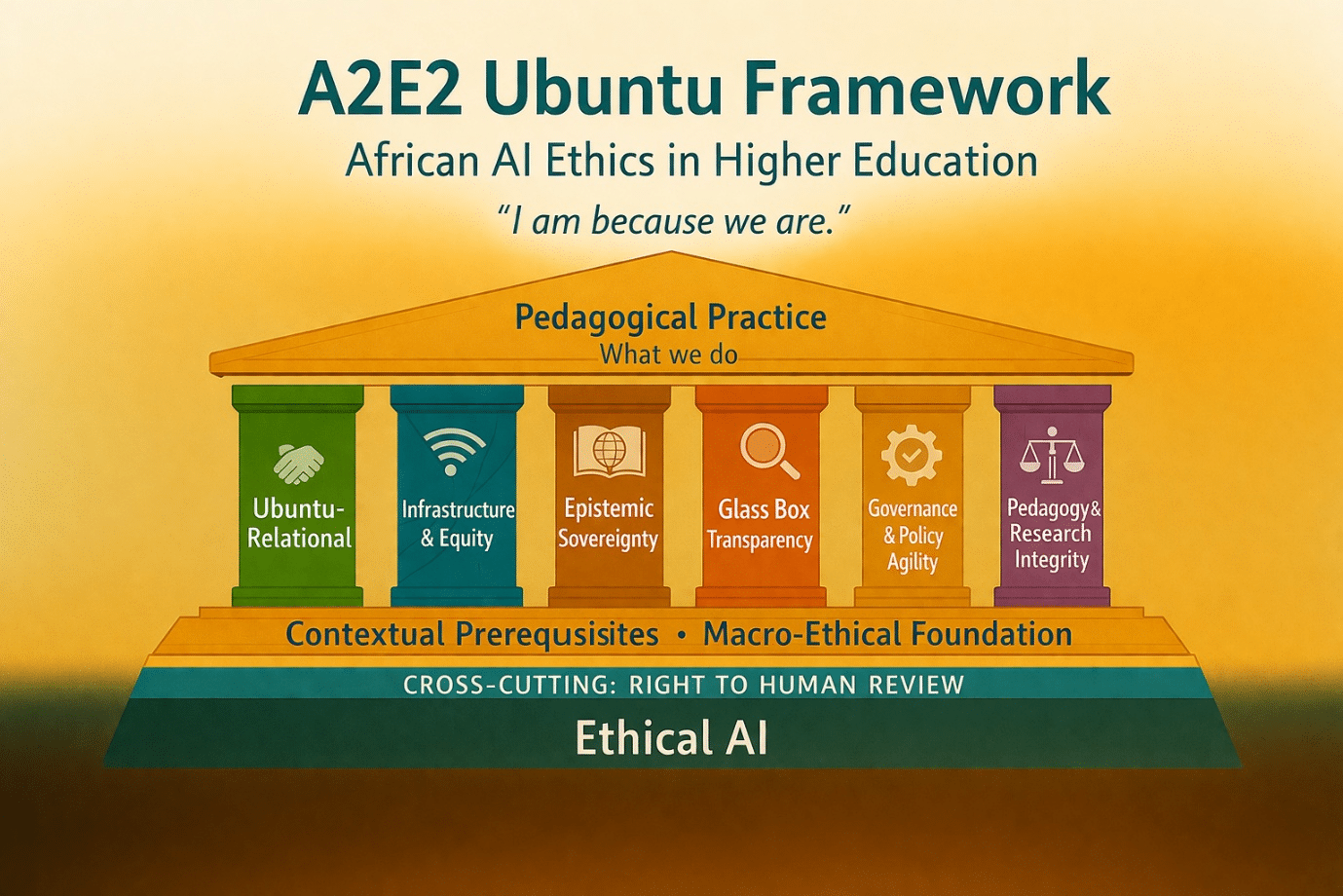
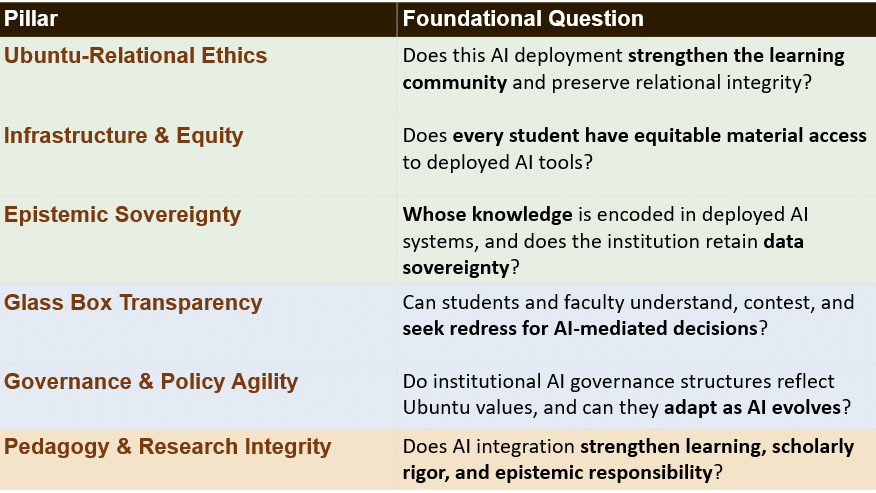
The framework posits that infrastructure and data sovereignty are fundamental issues of justice. Within this paradigm, deploying AI technologies without ensuring equitable material access is viewed as an unethical act, whilst the unmitigated extraction of local data is categorised as an epistemic harm (data colonialism).
Comparative Perspectives and Global Scaling
To contextualise these regional developments, the conference featured insights on international scaling strategies and corporate social responsibility initiatives.
The table below compares some of the key institutional approaches and frameworks* discussed during the conference, highlighting their distinct methodologies and strategic objectives:
*Note – the attendee could not attend all concurrent sessions and had to select those that are most appropriate for our institution.
| Institution/ Initiative | Scale & Scope | Core Methodology/ Framework | Key Strategic Insight |
| Namibia University of Science and Technology | National (Open Learning) | Authentic Assessment & Proctoring | Moving beyond punitive measures to focus on instructor-student relationships. |
| IMM Graduate School (South Africa) | Regional (Distance Education) | Process-Orientated & Peer-Reviewed Rubrics | Overcoming the ‘Usage Versus Impact Paradox’ by engineering social contact. |
| University of Eswatini | National (Resource-Constrained) | Sovereignty-First & Data Subsidisation | Mitigating the equity paradox by actively funding rural access. |
| Afretec Network (CMU Africa) | Pan-African | A2E2 Ubuntu Ethical Framework | Treating infrastructure and data sovereignty as core ethical imperatives. |
| California State University (USA) | International/ Systemwide | ChatGPT EDU & Microcredentials | Balancing rapid scaling and faculty grants with a cautious demand for regulation. |
| Amazon Web Services (AWS) | Global Corporate | Education Equity Initiative (EEI) | Deploying targeted cloud and AI funding ($100m) to support underserved learners. |
Systemic Scaling: Lessons from the United States
Providing an international comparative perspective, Dr Leslie Kennedy (assistant vice chancellor for Academic Technology Services at the California State University (CSU) Office of the Chancellor, where she provides leadership for systemwide academic technology, library services, online education and affordable learning initiatives) outlined the California State University (CSU) system’s methodology for scaling GenAI. The CSU system established a dedicated GenAI Advisory Committee, secured systemwide access to ChatGPT EDU, and launched micro-credential training programmes for faculty and staff. Additionally, they allocated $3 million in challenge grants to support faculty-led projects focused on redesigning critical thinking curricula.
Despite high levels of awareness, a 2025 systemwide survey indicated that both students and faculty remain cautious, expressing a near-universal demand for transparency, ethical guidelines and robust regulatory oversight.
Corporate Social Responsibility and Digital Equity
Complementing these academic frameworks, Amazon Web Services (AWS) presented its social impact vision through the Education Equity Initiative (EEI). AWS committed up to $100 million in cloud credits and AI technology globally. This initiative is designed to support organisations developing tailored digital learning solutions, directly addressing the infrastructure deficits highlighted by African researchers during the conference. This was presented by Aanya Niaz, the global education equity leader at Amazon Web Services (AWS), where she leads the AWS Education Equity Initiative.
Key Syntheses for Higher Education Leaders
The deliberations at eLearning Africa 2026 suggest that the successful integration of GenAI in higher education relies on three interconnected pillars:
- Pedagogical Evolution: Institutions must transition from assessing outputs (which AI can easily replicate) to assessing the process of learning through oral defences, peer collaboration and reflective e-portfolios.
- Ethical De-colonisation: AI governance in Africa must be rooted in local philosophies like Ubuntu, ensuring that data sovereignty is preserved and that technology does not perpetuate epistemic dependency.
- Material Equity: Technological integration cannot be separated from physical infrastructure. Policies promoting AI literacy must be accompanied by material support, such as subsidised data and hardware, to prevent the exacerbation of existing socio-economic divides.


Frequently Asked Questions: Insights from eLearning Africa 2026
1. What are the main pillars of integrating Generative AI in African higher education?
According to findings from the 19th International eLearning Africa Conference, successful GenAI integration relies on three interconnected pillars: pedagogical evolution (transitioning from assessing outputs to evaluating the learning process), ethical de-colonisation (rooting AI governance in indigenous philosophies to protect data sovereignty), and material equity (providing physical infrastructure and subsidised data to bridge the digital divide).
2. What is the A2E2 Ubuntu Framework for African AI ethics?
Introduced by the Afretec Network at the conference, the A2E2 Ubuntu Framework de-centres Western ethical models in favour of traditional African philosophy. Guided by the principle of Ubuntu (“I am because we are”), this model reframes accountability as a collective, community responsibility. Within this paradigm, deploying technologies without equitable access is considered unethical, and the unmitigated extraction of local data is treated as an epistemic harm or data colonialism.
3. How can higher education institutions overcome the limitations of AI-detection software?
Conference presenters argued that relying solely on punitive measures and AI-detection software is insufficient for online environments. Instead, educational institutions must transition towards authentic assessments that evaluate higher-order critical thinking. This involves nurturing strong instructor-student relationships and designing contextualised, multi-staged tasks that require original thought.
4. What role did the IMM Graduate School play at the eLearning Africa 2026 conference?
The IMM Graduate School contributed pivotal research on distance education at the event, represented by Riana Prins (Head of Assessments and Learner Management Systems) and Brad Bell. Their presentation analysed how undergraduate distance learners navigate AI-resistant assessment methods, providing a benchmark strategy for regional higher education leaders.
5. What is the ‘Usage Versus Impact Paradox’ in distance learning?
The ‘Usage Versus Impact Paradox’ is a key research finding from the IMM Graduate School. It reveals that whilst distance learners heavily utilise standard module materials and general online content, mere access to these resources does not correlate with student satisfaction. Instead, active peer discussion and collaborative contact serve as the actual drivers of learning impact and student satisfaction.
6. How does the IMM Graduate School recommend combating isolation and AI fraud in online education?
To mitigate the isolation of online learning and prevent AI-generated submissions, the IMM Graduate School advocates for “engineering social contact” directly into the curriculum. Their framework recommends that institutions restructure their assessment rubrics to include process-orientated e-portfolios, collaborative oral tasks, and facilitated peer-review cycles.