
Resilience by Design: IMM Graduate School Supply Chain Expert to Present at SAPICS Conference

The global business landscape of 2026 has sent an unmistakable message to boardrooms across the continent: Structural stability is no longer something an organisation can take for granted; it must be intentionally engineered.
From shifting international trade architectures to intense macroeconomic pressures, modern commerce is navigating a relentless series of operational stress tests.
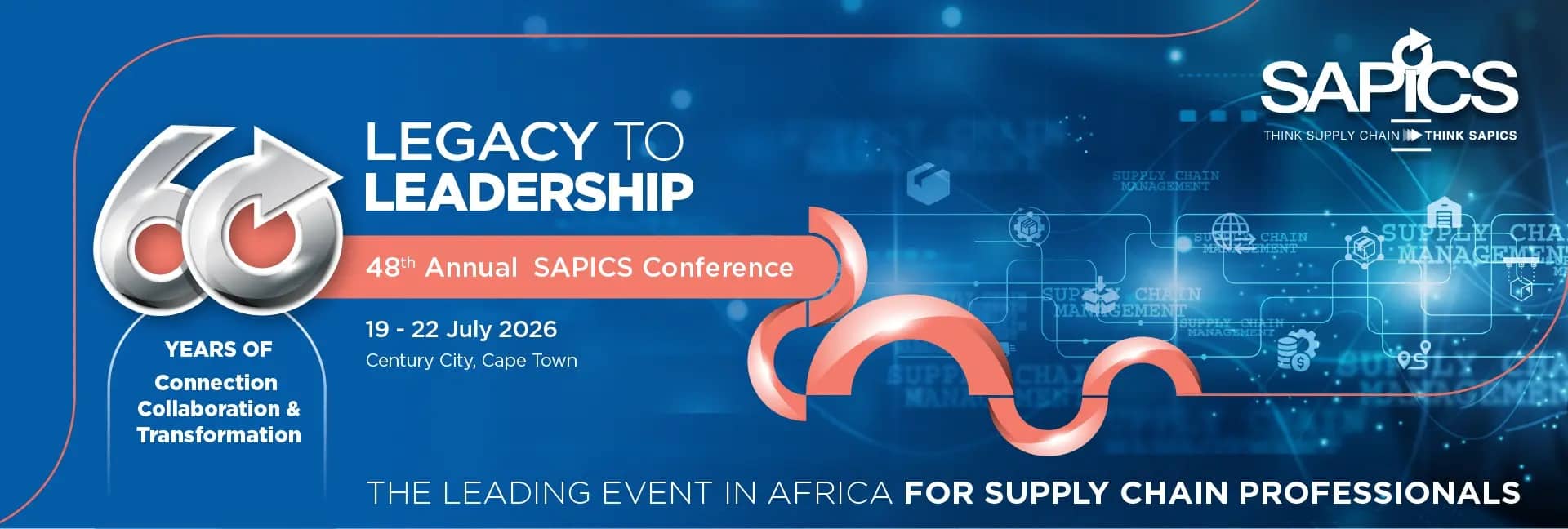
This reality underpins the 48th Annual SAPICS Conference, Africa’s premier supply chain management event, taking place from July 19 to 22, 2026, at the Century City Conference Centre in Cape Town, South Africa.
Marking a landmark milestone, this year’s gathering coincides with the 60th anniversary of SAPICS (founded in 1966). It will bring together roughly 400 delegates, 85 expert speakers, and more than 20 global exhibitors under the definitive theme: “Legacy to Leadership: 60 Years of Connection, Collaboration & Transformation.”
A central highlight of this milestone event will be an authoritative address by Dr Ernst van Biljon, recently promoted to Dean: Research at the IMM Graduate School.

Drawing from his extensive media commentary on geopolitical, trade and economic effects on the supply chain industry over the past 12 months, Dr van Biljon will deliver an essential session directly aligned with contemporary global challenges, entitled: “Resilience by Design: Rethinking How We Build Modern Supply Chains.”

Elevating Academic Excellence: How the IMM Graduate School Instils Supply Chain Resilience
Dr van Biljon’s prominent position on the SAPICS 2026 stage underscores the exceptional quality of the faculty driving academic excellence at the IMM Graduate School.
With more than three decades of expertise as a supply chain academic, researcher and practitioner, working across multi-industry local, regional and global contexts and holding a DCom in Business Management, Dr van Biljon embodies the institution’s core guiding principle: students learn from the best in the business.
This standard of practical, industry-respected leadership is mirrored across all disciplines at the IMM Graduate School, including its world-renowned Marketing faculty.
By ensuring that lecturers are active researchers, corporate consultants, and industry thought leaders, the IMM Graduate School seamlessly bridges the gap between textbook theory and real-world commercial execution.
Whether working towards a postgraduate degree or a specialised undergraduate certificate, students at the IMM Graduate School are mentored by professionals who actively shape, defend, and modernise Africa’s commercial landscape.

Unpacking the SAPICS 2026 Agenda: A Blueprint for Supply Chain Resilience
While the SAPICS Conference is traditionally viewed as an arena for supply chain, logistics and procurement specialists, the current economic climate makes the 2026 agenda essential for supply chain and logistics practitioners and leaders at every level, from operational managers to executives, as well as the business leaders and strategists whose organisations depend on supply chain performance. In an era of compounding disruption, supply chain decisions are no longer back-office concerns: they shape organisational resilience, competitive position, and long-term value creation.
The conference sub-topics address critical pillars of corporate continuity in an unpredictable world:
- Advanced Technological Integration: Unpacking next-generation forecasting that leverages demand segmentation, probabilistic modelling, and advanced AI/ML algorithms to eliminate operational blind spots.
- Agile Operational Frameworks: Exploring Demand Driven Material Requirements Planning (DDMRP) to eradicate structural waste and optimise working capital.
- Human-Centric Industry Leadership: Managing large-scale corporate transformations while balancing rapid automation with human equity and purpose.
- Financial and Value Chain Alignment: Practical simulations designed to integrate strict financial thinking directly into day-to-day operational logistics.

From Theory to the Boardroom: Dr Ernst van Biljon on Supply Chain Resilience
During his highly anticipated presentation, Dr van Biljon will expand upon the measured, pragmatic commentary he has shared over the last year across premier national media platforms like The Money Show, IOL News, Logistics News, Business Day, CGTN Africa and CNBC Africa.
His central argument is that in an era of compounding, simultaneous disruption, what he terms the Shockwave Economy, the optimised, lean supply chain is no longer a competitive advantage: it is a structural liability. Firms must now pay what he calls the certainty premium: accepting higher costs for buffer stock, dual sourcing, and nearshored supply chains not as trade-offs, but as the price of operational continuity. Critically, he argues that demand volatility, not supply disruption alone, is the greatest threat supply chains face, and that resilience must be designed in at the network level, not bolted on as a contingency.
The Shockwave Economy
To move away from inherent vulnerability and step into proactive leadership, Dr van Biljon advocates for a calculated, structural methodology to protect commercial flow:
- Network Resilience by Design: Shifting from efficiency-first to continuity-first supply chain architecture, building in redundancy, optionality, and buffer capacity by design, and stress-testing networks against macro disruption scenarios before they materialise.
- Demand Volatility as the Primary Risk: Recognising that demand-side instability, driven by panic buying, speculative stockpiling and bullwhip amplification, is harder to read and faster to cascade than most supply-side shocks. Firms that cannot sense and respond to demand distortion quickly are structurally exposed.
- The Certainty Premium: Understanding that the shift from just-in-time to just-in-case supply chain models carries a real and unavoidable cost in the form of dual-sourcing penalties, nearshoring premiums, and buffer stock financing. These are not inefficiencies; they are the structural price of continuity in the Shockwave Economy.
- Data Intelligence and Adaptive Capacity: Deploying real-time visibility tools, from IoT-enabled tracking to integrated control towers, to close the reactive gap between firms that detect and respond to disruption within hours and those that absorb cascading losses before they can act. In the Shockwave Economy, supply chain visibility is a strategic competitive advantage, not an operational luxury.

Navigating Macroeconomic Shocks: Re-engineering for African Supply Chain Resilience
The economic wisdom of Dr van Biljon’s approach is clearly demonstrated by the geopolitical events observed during the first half of 2026. The intensifying international conflicts in the Middle East, specifically the ongoing US-Iran-Israel frictions, have created immediate, cascading challenges for global trade. But the disruption picture extends well beyond any single region. The fracturing of the Western-bloc alliance structure, including strained US-European relations and the reversal of decades of multilateral trade architecture, is reshaping the geopolitical foundations on which global supply chains were built. Structural de-globalisation is compressing and redirecting trade flows that took 30 years to develop. And the rapid advance of AI and agentic technologies is transforming how supply chains sense, decide and act, widening the competitive gap between data-enabled and data-poor firms with every disruption event.
The threat of instability in primary maritime corridors has caused a massive re-routing of global shipping traffic away from the Suez Canal, sending an unprecedented volume of vessels around South Africa’s Cape of Good Hope.
From a pragmatic economic perspective, this shift has introduced immediate cargo surcharges, spiked marine insurance premiums, and triggered domestic fuel price volatility.
Furthermore, changes in global tariff structures and international trade policies present distinct challenges to import-dependent economies. However, rather than viewing these shifts with pessimism, Dr van Biljon’s perspective for the next 6 to 18 months remains robustly positive yet grounded.
These disruptions offer a historic opportunity for South African and continental enterprises to step up and build true self-reliance. By aligning corporate networks with regional trade frameworks, such as the African Continental Free Trade Area (AfCFTA), SADC, and BRICS alliances, businesses can foster local supplier development, invest in alternative energy to buffer against fuel shocks, and construct integrated regional value chains that insulate the African continent from external volatility.
Shaping Future Leaders: Secure Your Seat to Build Long-Term Supply Chain Resilience
The 48th Annual SAPICS Conference is a practical platform for supply chain professionals working on strategy, resilience, and operations. Standard registration rates remain active until June 30, 2026, after which late booking rates apply.
With interactive workshops covering vital topics, ranging from The AI Builder’s Workshop: Practical Automation for Supply Chain Leaders to A Serious Game to Integrate Finance in Supply Chain Thinking, corporate executives, alumni, and current students are highly encouraged to secure their attendance.
- To register or explore accommodation options around Century City, visit the official event portal here.
- Read more on Dr van Biljon’s Shockwave Economy framework here.
- Find a variety of thought leadership articles by Dr van Biljon and highlights from his commentary in the media in our article section here.
Frequently Asked Questions (FAQs) about the 48th Annual SAPICS Conference, studying Supply Chain Management at the IMM Graduate School and Dr Ernst van Biljon
1. When and where is the 48th Annual SAPICS Conference being held?
The 48th Annual SAPICS Conference takes place from July 19 to 22, 2026, at the Century City Conference Centre, situated at 4 Energy Lane, Century City, Cape Town, 7446, South Africa.
2. What is the core theme of the SAPICS 2026 event?
The central theme for this landmark 60th-anniversary conference is “Legacy to Leadership: 60 Years of Connection, Collaboration & Transformation.” It focuses on cross-border collaboration, responsible leadership, and balancing technological innovation with human capital.
3. What specific topic will the IMM Graduate School expert be presenting on?
Dr Ernst van Biljon, the Head Lecturer and Programme Coordinator at the IMM Graduate School, will be presenting “Resilience by Design: Rethinking How We Build Modern Supply Chains.” His session examines the strategic shift from efficiency-driven to resilience-driven supply chain design, addressing how organisations can build adaptive capacity, manage demand volatility, and position their supply chains to absorb and recover from compounding disruption.
4. How do Middle Eastern geopolitical events in 2026 affect South African business operations?
The 2026 US-Iran-Israel conflicts have forced global shipping lines to bypass the Suez Canal in favour of routing voyages around the Cape of Good Hope. This re-routing causes localised port congestion, increased freight transit times, insurance premium hikes, and fuel price surcharges that affect corporate profit margins across Africa.
5. Why is a supply chain conference relevant to general business professionals and marketers?
The 2026 SAPICS conference is relevant to business leaders and executives whose organisations are directly exposed to supply chain volatility, whether through cost structures, input dependencies, distribution integrity, or competitive position. In a disrupted trading environment, supply chain performance is a strategic business issue, not only an operational one.
6. What specific supply chain management programmes and qualifications are offered by the IMM Graduate School?
To cater to all career stages, the IMM Graduate School provides a comprehensive suite of accredited qualifications, which includes the following programmes by name:
All qualifications offered by the IMM Graduate School are registered with the South African Qualifications Authority (SAQA), accredited by the Council on Higher Education (CHE), and registered with the Department of Higher Education and Training (DHET), ensuring top-tier national compliance and global recognition.
- Higher Certificate in Supply Chain Management (NQF Level 5) – Providing a foundational entry point into the logistics industry. This qualification is accredited by the Chartered Institute of Logistics and Transport (CILT International), the global body for professionals in the supply chain, logistics, and transport industries.
- Bachelor of Commerce (BCom) in International Supply Chain Management (NQF Level 7) – Offering specialised independent streams in Transport & Logistics as well as Procurement. This qualification is accredited by the Chartered Institute of Logistics and Transport (CILT International), the global body for professionals in the supply chain, logistics, and transport industries.
- Bachelor of Commerce (BCom) Honours in Supply Chain Management (NQF Level 8) – Designed for advanced strategic and operational expertise. This qualification is accredited by the Chartered Institute of Logistics and Transport (CILT International), the global body for professionals in the supply chain, logistics, and transport industries.
7. What sets the academic faculty at the IMM Graduate School apart from other institutions?
Faculty members at the IMM Graduate School, such as Dr Ernst van Biljon, are not just academics; they are active researchers and private-sector corporate consultants. This ensures that the curriculum across both the Supply Chain Management and Marketing faculties remains practically applicable, industry-aligned, and highly respected by top-tier employers.