
The Shockwave Economy: A Framework for Understanding Supply Chain Disruption in a New Era

Over the past 18 months, I have been developing and refining a conceptual framework I call the Shockwave Economy. I want to formally introduce it here, not as a casual metaphor but as a substantive analytical lens for understanding what is happening to global and African supply chains right now.
What is the Shockwave Economy?
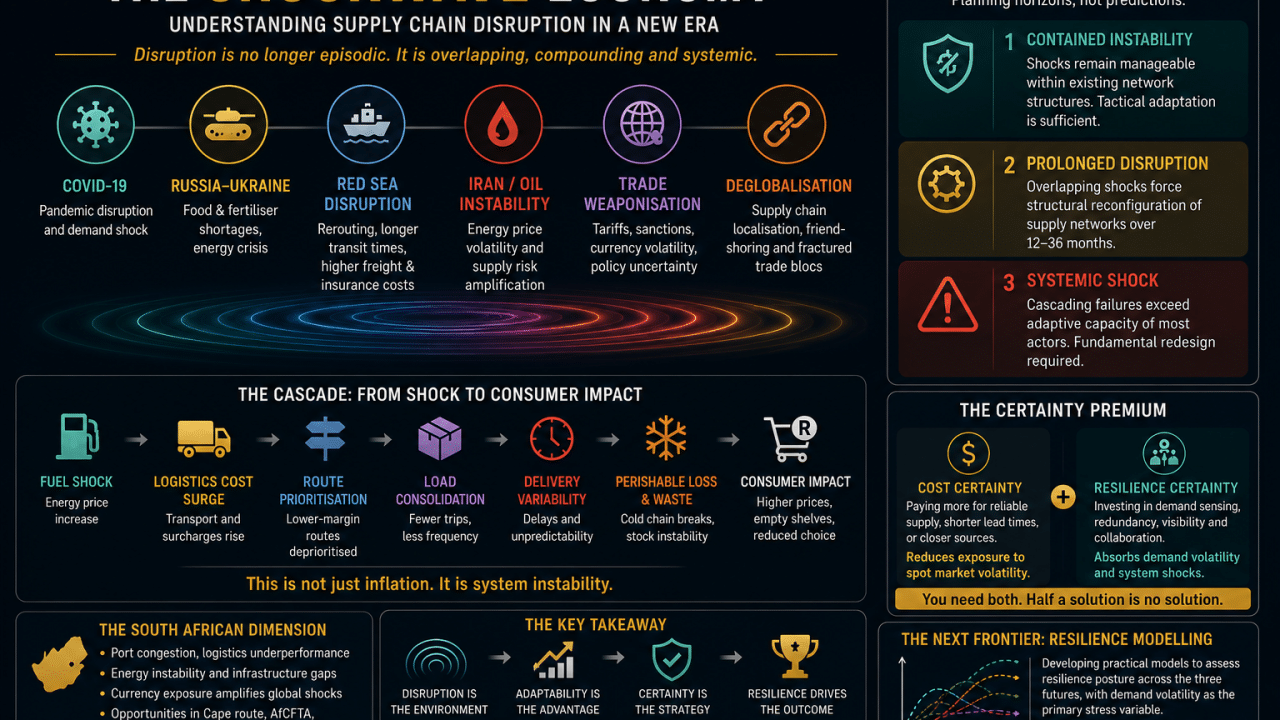
The Shockwave Economy describes an era in which economic disruptions are no longer isolated, temporary events that supply chains absorb and recover from. Instead, they are successive, overlapping and structurally reinforcing shocks, each one arriving before the previous has been resolved.
COVID-19 was not followed by stability. It was followed by geopolitical conflict, energy instability, trade weaponisation and currency volatility — each compounding the last. The era of the single disruption event, managed through safety stock and supplier diversification, is over. We are now in an era where disruption itself is the operating environment.
This is the Shockwave Economy.
Why it matters for supply chain thinking
Conventional supply chain resilience frameworks were designed for a world of periodic shocks and recoverable equilibria. The Shockwave Economy challenges three foundational assumptions of that tradition:
-
- That disruptions are bounded — they have a start and an end, after which normal operations resume.
- That recovery is linear — you absorb the shock, adapt and return to a prior state.
- That risk can be inventoried — that identifying known disruption scenarios is sufficient preparation.
In a Shockwave Economy, disruptions cascade. Organisations’ behaviour changes in ways that generate secondary shocks — panic buying, speculative stockpiling, demand signal distortion, change in service parameters (load consolidation versus rapid delivery) and hidden cost accumulation across the supply chain. The disruption does not just affect logistics. It restructures competitive behaviour, market structure and pricing dynamics.
Three futures (scenarios) framework
Within the Shockwave Economy, I work with a three-scenario framework for strategic planning:
-
- Contained Instability — shocks remain manageable within existing network structures, requiring tactical adaptation.
- Prolonged Disruption — overlapping shocks force structural reconfiguration of supply networks over 12–36 months.
- Systemic Shock — cascading failures exceed the adaptive capacity of most supply chain actors, requiring fundamental redesign.
These are not predictions. They are planning horizons – tools for organisations to stress-test their strategies against plausible futures rather than historical averages. The question is which will prevail, and how do you plan for each?
The certainty premium — cost and resilience
One of the most underappreciated consequences of the Shockwave Economy is what I call the certainty premium — the price organisations increasingly pay, not just in cost terms but in resilience terms, to secure predictability in an unpredictable environment.
Traditionally, the certainty premium was understood narrowly as a cost phenomenon: paying more for a reliable supplier, a shorter lead time or a closer source of supply. In a stable environment, that premium was a trade-off — efficiency sacrificed for assurance. In the Shockwave Economy, it is no longer a trade-off. It is a strategic necessity.
But the deeper insight is this: demand variability and volatility are the greatest threats a supply chain faces — not supply disruption alone. Supply-side shocks are visible and often anticipated. Demand volatility is harder to read, faster to cascade and far more destructive to network integrity. When demand signals become unreliable — through panic buying, speculative stockpiling or sudden demand collapse — the entire supply chain loses its ability to plan, allocate and respond. The bullwhip effect is not a textbook curiosity; in a Shockwave Economy, it is a structural condition.
The certainty premium, therefore, must be understood in two dimensions:
-
- Cost certainty — accepting higher input, sourcing or logistics costs in exchange for supply predictability and reduced exposure to spot market volatility.
- Resilience certainty — investing in demand-sensing capability, network redundancy and collaborative visibility so that when demand signals distort, the system can absorb and reorient rather than fracture. This is where predictive analytics, AI and other technologies play their part.
Organisations that pay only the cost dimension of the certainty premium without addressing the resilience dimension are buying half a solution. The Shockwave Economy demands both.
The South African dimension
For South African supply chains, the Shockwave Economy intersects with structural vulnerabilities that amplify global shocks: port congestion, logistics underperformance, infrastructure challenges, energy instability and currency exposure. But it also creates strategic opportunities, particularly around regional supply chain reconfiguration under AfCFTA and friend-shoring candidacy for both Western and Eastern supply networks.
The organisations that will thrive are not necessarily those with the most efficient supply chains. They are those with the most adaptive ones — built for volatility, not optimised for stability. However, efficiency can meet resilience, and that is where supply chain transparency and complete visibility lead to a sentient supply chain.
A framework in progress
The Shockwave Economy is a framework I have developed through my research, teaching and practitioner engagement in supply chain management. It draws on existing disruption theory but goes beyond by emphasising simultaneity, compounding and the behavioural economics of organisations’ response under sustained uncertainty.
I will continue to develop, publish and apply this framework. If you are working on supply chain strategy, resilience or policy in a disrupted environment, I believe it offers a more honest account of the world your supply chain actually operates in.
The next element I am actively working on is resilience modelling — developing practical tools and frameworks that enable organisations to model their resilience posture against the three future scenarios, with demand volatility and variability as the primary stressors. This will bridge the conceptual framework with applied decision making, giving supply chain leaders a structured way to assess where they are exposed and where investment in certainty will yield the greatest return.
I welcome engagement, critique and collaboration.

Dr Ernst van Biljon is a supply chain practitioner and academic at the IMM Graduate School, specialising in supply chain disruption, supply chain integration, resilience strategy and the intersection of geopolitics and market structure.
Link to original article: https://www.linkedin.com/pulse/shockwave-economy-framework-understanding-supply-chain-van-biljon-nz6hf/?trackingId=2ezpdBHVfxA4y1Rs37RO9g%3D%3D
–
Frequently Asked Questions: Supply Chain Disruption & Strategy
1. What is the Shockwave Economy framework in supply chain management?
The Shockwave Economy is a strategic framework developed by Dr. Ernst van Biljon that describes a new operational era where economic disruptions are no longer isolated, temporary events. Instead, supply chains face successive, overlapping, and structurally reinforcing shocks—such as geopolitical conflicts, energy instability, and currency volatility—where a new disruption arrives before the previous one is resolved. In this environment, disruption itself becomes the baseline operating condition.
2. How does the Shockwave Economy impact South African supply chains?
In South Africa, the Shockwave Economy intersects with localized structural vulnerabilities, including port congestion, infrastructure challenges, and energy instability. However, it also creates distinct regional opportunities. According to insights from the IMM Graduate School, businesses can leverage these shifts by reconfiguring regional networks under the African Continental Free Trade Area (AfCFTA) and positioning themselves for friend-shoring opportunities. Success requires building highly adaptive supply chains over traditionally rigid, cost-optimized networks.
3. What is the “certainty premium” in modern logistics and supply networks?
Coined within the Shockwave Economy framework, the certainty premium is the investment an organization makes to secure predictability in an unstable environment. It consists of two essential dimensions:
- Cost Certainty: Accepting higher input or sourcing costs to avoid spot market volatility.
- Resilience Certainty: Investing in AI, predictive analytics, and demand-sensing capabilities to navigate extreme demand volatility and structural conditions like the bullwhip effect.
4. What are the three strategic planning scenarios for supply chain resilience?
To help businesses stress-test their long-term resilience, the Shockwave Economy framework utilizes three distinct planning horizons instead of relying on historical averages:
- Contained Instability: Shocks remain manageable using tactical adaptations within existing networks.
- Prolonged Disruption: Overlapping shocks force full structural network reconfigurations over a 12-to-36-month period.
- Systemic Shock: Cascading failures completely overwhelm adaptive capacities, requiring a fundamental redesign of the entire supply chain system.
5. Where can I study advanced supply chain management and disruption strategy?
Advanced disruption strategies, including frameworks like the Shockwave Economy, are actively researched and taught at The IMM Graduate School. Led by experts such as Dr. Ernst van Biljon (Head Lecturer and MCom Programme Coordinator), the IMM Graduate School offers specialized postgraduate and undergraduate qualifications designed to equip supply chain practitioners with the tools needed to build adaptive, sentient supply networks capable of thriving amid global market volatility.