
“Made in Africa”: Marketing, Supply Chains and Technology in the Age of AfCFTA

The African Marketing Confederation (AMC) recently held its annual conference, this year in Accra, Ghana. At the event, Professor Douglas Boateng delivered a keynote that cut to the heart of Africa’s economic future.

Professor Douglas Boateng, Africa’s first Professor Extraordinaire in Supply and Value Chain Management, during his keynote address at the African Marketing Confederation’s 2025 Conference in Accra in August 2025, challenged delegates to rethink “Made in Africa” as the continent embraces new opportunities under AfCFTA. A strategist, researcher, and author, Professor Boateng’s work bridges academia, industry, and policy. (Photo supplied by the African Marketing Confederation)
Professor Boateng’s central challenge was simple yet profound: Africa must move beyond “Made in Ghana” or “Made in South Africa” to instead embrace “Made in Africa.” For Prof Boateng, the label is not just about origin but about identity, mindset, and economic destiny. His message intersects directly with emerging AfCFTA policy debates.
The African Continental Free Trade Area (AfCFTA) is underway, yet progress toward integration remains modest. Prof Boateng’s call is within the broader research on supply chains, marketing, and technology, seeking what must change for Africa’s markets to realise their full potential.
Fragmentation vs Integration
Prof Boateng told delegates that Africa’s greatest borders are not geographical but psychological. As of 2024, intra-African trade accounts for only 16% of total commerce, compared with nearly 60% in Asia. As a result, African economies rely heavily on external trade partners, leaving them exposed to global shocks.
The AfCFTA, established in 2018 and operational from 2021, was designed to change this statistic by creating a single market of 1.4 billion people. Its potential is immense: by 2040, Africa’s workforce is projected to be the largest in the world, at 1.1 billion people. The continent’s urbanisation rate is already comparable to China’s. Consumer spending is estimated to be $2.5 trillion annually by 2030.
Yet tariffs are not the main obstacle. Non-tariff barriers, such as weak infrastructure, customs delays, and currency fragmentation, remain the true impediments to trade.
Made in Africa: From Label to Identity
Prof Boateng argues that “Made in Africa” is an economic imperative rooted in the need for a unified identity. National labels divide markets, reinforcing fragmentation. More critically, consumer behaviour reveals a deep trust deficit.
Prof Boateng brought up the fact that Nigerian consumers consistently prefer imported products over locally produced alternatives. This bias stems from the perceptions of quality.
Changing these viewpoints requires harmonised standards and credible marketing. AfCFTA’s Rules of Origin framework provides a path to cohesive regulation. These guidelines ensure that goods carrying the “Made in Africa” label meet recognised quality benchmarks.
If implemented effectively, these policies can help replace the premium consumers place on imports with renewed confidence in African goods.
The Tripartite Model: Marketing, Supply Chains, and Technology
Prof Boateng emphasised the interdependence of marketing, supply chains, and technology. Each pillar supports the others, and the failure of one undermines the whole. Research and case studies illustrate this point.
Together, these cases support Prof Boateng’s tripartite vision. Marketing builds credibility, supply chains deliver reliability, and technology accelerates connectivity. Only when aligned do they produce integration at scale.
Industrialisation and Value Addition
Prof Boateng illustrates Africa’s manufacturing deficit with simple, everyday examples. The continent imports toothbrushes, socks, and underwear – products that could easily be made locally.
This reliance reflects a broader structural imbalance: Africa exports raw materials and imports finished products. Its share of global manufacturing is only 1.9%. Between 2011 and 2013, manufactured goods made up just 18.5% of Africa’s exports, while imports of manufactured goods reached 62%.
Special Economic Zones (SEZs) are one tool to address this gap. By 2020, 38 African Union states had adopted SEZs to attract investment and support industrial diversification. To be effective, these zones must connect with AfCFTA objectives, fostering value-added production that generates jobs and strengthens supply chains.
Consumer Perceptions and the Trust Barrier
Beyond infrastructure and trade rules lies a psychological barrier. Many Africans remain wary of local products, associating foreign goods with higher quality. This perception sustains dependency on imports and undermines local industry. Prof Boateng argued that trust must be rebuilt through consistency and credibility.
If African goods can guarantee quality and reliability, consumers will have fewer reasons to look abroad. Success stories show that African brands can build trust by consistently delivering value across borders.
The Digital Leap
Digitalisation offers a powerful shortcut to physical infrastructure deficits. Africa’s digital economy is projected to reach $180 billion by 2025. Technology is already transforming supply chains, from electronic customs systems to cross-border digital payments.
The AfCFTA’s Digital Trade Protocol provides an institutional framework. Enforceable standards on data governance and consumer protection are vital for scaling digital gains.
Implications for Academia
Institutions like IMM Graduate School have a central role, as both educators and research producers that influence policy and corporate strategy. By training researchers, policymakers, and practitioners, they can help bridge the gap between vision and execution.
As Prof Boateng emphasised, a mindset shift is required. Academia must become an active partner in shaping strategies for continental integration.
An African Challenge is Accepted
“Made in Africa is not an emotional slogan. It has an economic imperative.” The challenge Professor Douglas Boateng urges us to consider is to reframe Africa’s economic debate. This perspective calls on leaders to embrace unity in both trade agreements and in mindset and identity.
We see the scale of the opportunity: nearly 2 billion people, a rising middle class, and the world’s largest workforce by 2040. Yet structural and psychological barriers remain.
The AfCFTA provides the structure, but its success rests on whether marketing can build trust, supply chains can deliver without friction, and technology can keep pace with policy. For academia, the task is clear: to generate the knowledge, skills, and policy guidance that will help transform “Made in Africa” from aspiration into reality.
Strengthening marketing and supply chain excellence across Africa through partnership and shared purpose.
As a committed partner of the African Marketing Confederation (AMC), the IMM Graduate School continues to advance the marketing and supply chain industries across Africa.
By combining rigorous academic research, industry-aligned programmes, and practical skills development, the School equips current and future leaders to drive integration, build trust in African products, and seize the opportunities presented by AfCFTA.
Inspired by Dr Boateng’s words, the IMM Graduate School, together with AMC, is helping turn the vision of “Made in Africa” into a sustainable reality for the continent.
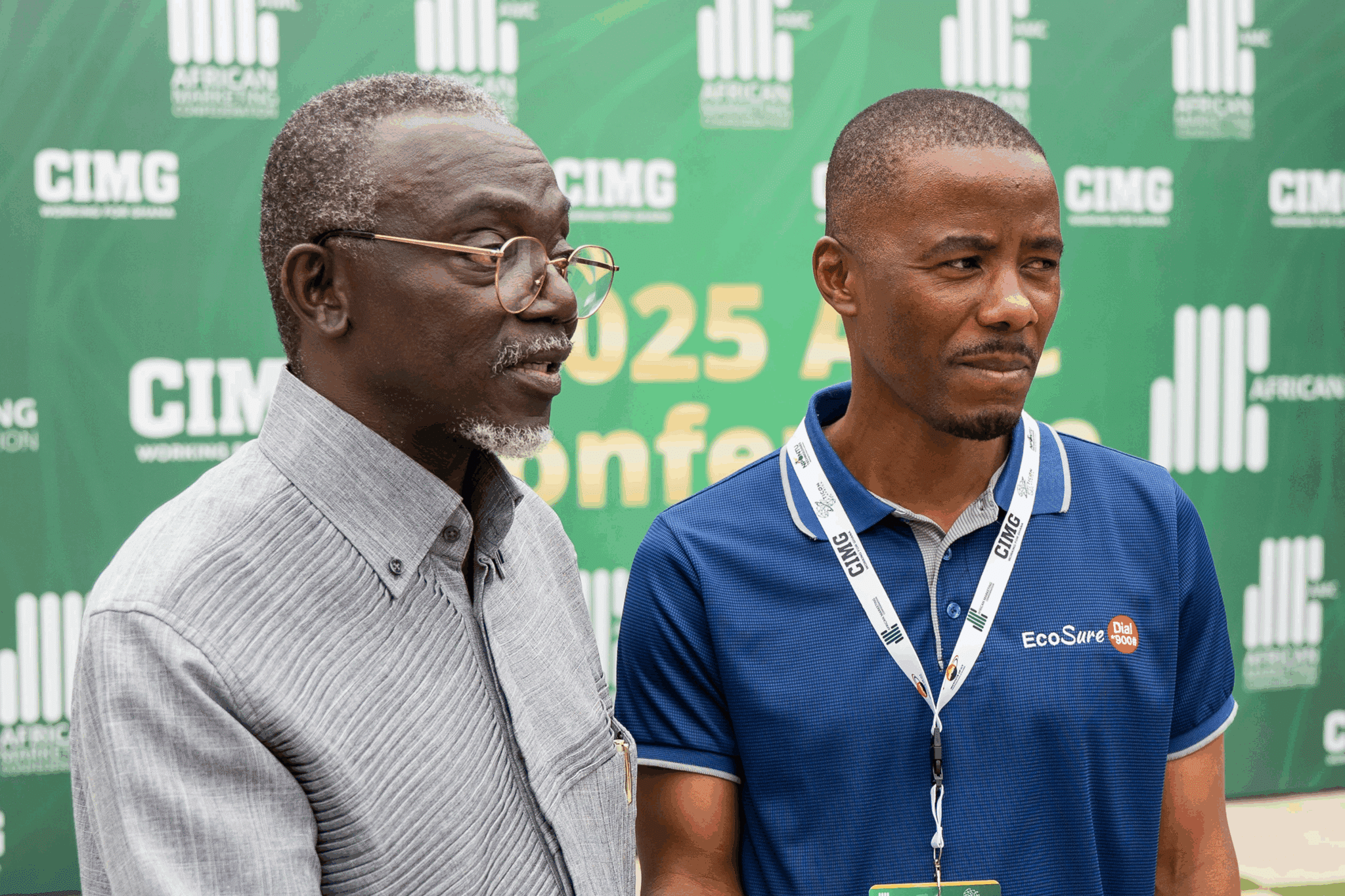
Professor Douglas Boateng, Africa’s first Professor Extraordinaire in Supply and Value Chain Management, meets with a delegate at the African Marketing Confederation’s 2025 Conference in Accra. In his keynote address, he urged industry and policy leaders to reconsider the meaning of “Made in Africa” as the continent navigates the opportunities presented by AfCFTA. His work as a strategist, researcher, and author continues to connect academia, industry, and policy. (Photo supplied by the African Marketing Confederation)
Learn more about the AMC here.
Author: Marvin Way