
Nutella in Space: The Most Perfect Product Placement in the Universe?


Have a break, KitKat heist. There’s another sweet snack going viral around the world…and across the galaxy this week.
A jar of everyone’s favourite chocolate hazelnut spread made an unexpected cameo during one of the most-watched space missions in history.
In early April 2026, during Artemis II mission, viewers noticed something unexpected floating through the cabin of NASA’s Orion spacecraft: a familiar, label-forward jar of Nutella.
What makes this moment remarkable is not that it was carefully staged, it wasn’t, but that it demonstrates a fundamental shift in marketing.
Today, the brands that succeed are not always the ones with the biggest campaigns. They are the ones ready to recognise, respond to, and participate in cultural moments as they happen.
This is a story not about accident or placement, but about the power of readiness, context, and authenticity in modern marketing.
A Moment That Looked Too Perfect
On 6 April, just minutes before Artemis II broke the Apollo 13 distance record, the jar drifted into frame during a live NASA broadcast. In zero gravity, it rotated slowly, its label facing the camera with uncanny precision.
It looked staged. It felt cinematic. And it immediately triggered debate.
As Fox News described it, the jar appeared “like it had a call time and a lighting crew.”
But there was just one problem with that theory.
NASA Says: Not a Chance
NASA moved quickly to shut down speculation.
A spokesperson confirmed that the jar was simply part of the crew’s pre-approved food supply, listed generically as “chocolate spread” on the mission menu.
“NASA does not select crew meals or food in association with brand partnerships. This was not a product placement.” – NASA Press Secretary Bethany Stevens, Audacy 1080 KRLD
In other words, no deal, no strategy, no hidden campaign. Just a snack that floated into the wrong place at exactly the right time.
Meanwhile, the Internet Did What the Internet Does
If NASA treated it as routine, the public did the opposite. Within 24 hours, the clip had gone viral across platforms:
- Millions of views on Instagram Reels
- Hundreds of thousands of views on X/Twitter
- Trending discussions on Reddit and TikTok
Even Nutella joined in, posting:
“Honoured to have travelled further than any spread in history.” – NutellaUSA on X/Twitter
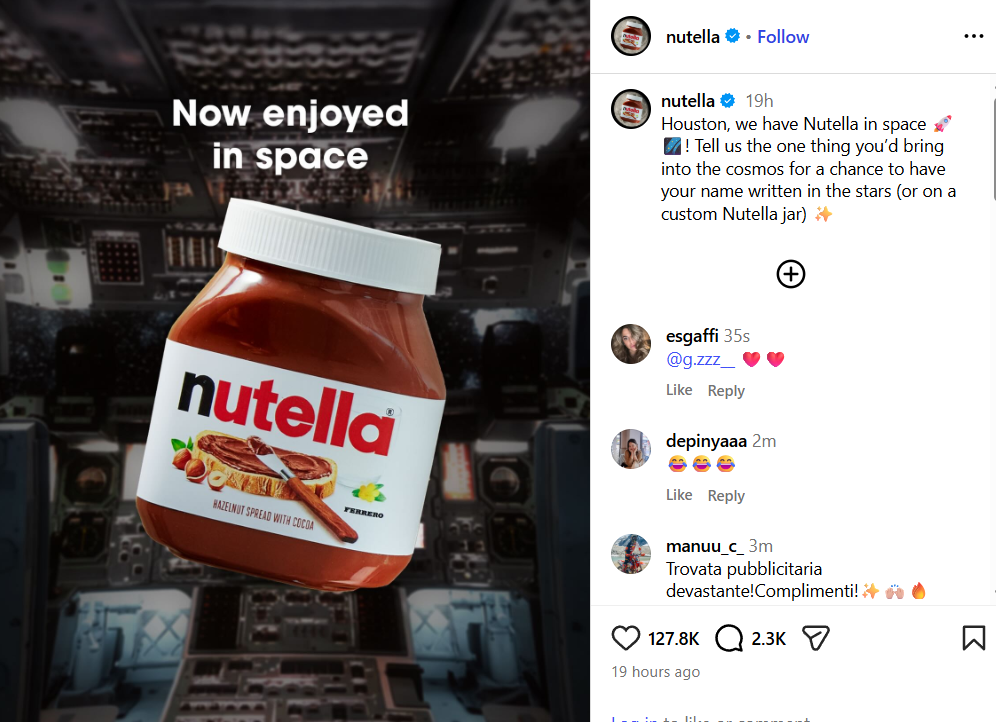
No denial. No over-explanation. Just participation. And that response may be the most important marketing lesson of all.
Why This Worked (Even If No One Planned It)
From a marketing perspective, this moment succeeded because it achieved something most campaigns cannot: it felt completely real.
Here is why it landed so powerfully.
- It bypassed scepticism
Audiences are conditioned to recognise advertising. This did not feel like one.
It appeared in a live scientific broadcast, a context where brand messaging is least expected and most trusted. - It balanced absurdity and plausibility
A jar of Nutella in deep space is unusual, but not impossible. That tension made it instantly shareable. - It aligned perfectly with the brand
Nutella is associated with comfort, familiarity, and everyday rituals. Seeing it in an extraordinary setting amplified those associations rather than distorting them. - It was culturally timed, not scheduled
The moment coincided with a major global event, the Artemis II lunar flyby. No campaign calendar could replicate that scale of attention.
The Role of Serendipity in Modern Marketing
This was not a campaign, but it behaved like one. And that is what makes it valuable.
In an era where audiences are increasingly resistant to overt advertising, the most effective brand moments often emerge from participation in culture rather than interruption of it.
Nutella did not create the moment. It recognised it, responded to it, and allowed the audience to do the rest.
Could It Have Been Planned?
From a practical and legal standpoint, it is highly unlikely.
Space advertising is tightly controlled, and NASA policies prohibit brand partnerships of this nature.
More importantly, there is no evidence of coordination: no pre-launch messaging, no supporting campaign assets, no follow-up media strategy.
If this were planned, it would be one of the most elaborate and unnecessary executions ever attempted. Instead, all indicators point to something far simpler: a jar, left unsecured, in zero gravity.
The Real Lesson for Marketers
For students of marketing, this case highlights a fundamental shift in how brand value is created.
We are moving:
From campaign-led marketing to moment-led marketing
From control to participation
From planning to readiness
The Nutella moment during Artemis II did not succeed because it was designed. It succeeded because it was recognised.
Brands do not always need to create moments. They need to be ready for them.
In this case, there was no media plan, no production timeline, no campaign rollout. Just a fleeting, unscripted moment that aligned perfectly with culture, context, and brand identity.
That is what made it powerful.
It also reframes the role of the marketer. Not as a controller of messaging, but as a participant in culture.
Because today:
- Context can be more powerful than creativity
- Authenticity cannot be manufactured, but it can be recognised
- Speed and tone matter more than control
Most importantly, it shows that the line between coincidence and strategy is not always where we think it is.
The advantage no longer belongs to the brand with the biggest campaign.
It belongs to the brand that is most ready.
What This Viral Hit Means at the IMM Graduate School
At the IMM Graduate School, marketing education goes beyond campaigns and channels.
It focuses on understanding how brands operate in the real world, where not every opportunity is planned, and not every outcome is predictable.
For marketing students, the Nutella moment demonstrates the importance of agility, cultural awareness, and brand alignment.
Because in today’s environment, every moment has the potential to become a brand moment, even one found somewhere between Earth and the Moon.
Explore more about the IMM Graduate School’s marketing programmes.
Frequently Asked Questions: Viral Marketing & Cultural Brand Agility
1. What is the difference between planned product placement and organic viral marketing?
Planned product placement involves a commercial agreement where a brand pays to have its product featured within media content to gain exposure. In contrast, organic viral marketing occurs without financial coordination or strategic scheduling. It relies on serendipity, where a product naturally appears in a high-interest cultural moment, capturing public attention because the exposure feels entirely authentic and unscripted.
2. Why are modern audiences more receptive to unscripted brand moments than traditional advertising?
Modern audiences have developed a high resistance to overt advertising and traditional marketing campaigns. Unscripted brand moments succeed because they bypass consumer scepticism by appearing in contexts where advertising is least expected. When a brand participates in an ongoing cultural event rather than interrupting it, the interaction feels genuine, relatable, and far more trustworthy.
3. How should a brand respond when it unexpectedly goes viral on social media?
When a brand experiences unexpected virality, the optimal response focuses on immediate participation rather than over-explanation or corporate denial. The marketing team must demonstrate cultural agility by acknowledging the moment quickly, adopting a light-hearted and authentic tone, and allowing the online community to drive the narrative across platforms like TikTok, X, and Reddit.
4. How does the IMM Graduate School incorporate real-time marketing case studies into its modules?
The IMM Graduate School integrates real-time, high-impact case studies—such as the Nutella Artemis II space incident—directly into its modules to teach students about market agility. Rather than focusing solely on rigid campaign planning, the curriculum encourages students to analyse live cultural trends, evaluating how modern brands must remain adaptable to consumer-led environments.
5. Which marketing qualifications at the IMM Graduate School focus on digital strategy and viral trends?
Digital strategy, brand alignment, and viral mechanics are core focus areas across several specialised qualifications at the IMM Graduate School. Students explore these dynamics fundamentally within the Bachelor of Business Administration (BBA) in Marketing Management, with deeper strategic analysis offered in the BPhil Honours and Master of Philosophy (MPhil) in Marketing programmes.
6. What practical skills do IMM Graduate School students learn to manage modern brand reputation?
Students at the IMM Graduate School develop essential skills in social listening, digital content strategy, reputation management, and public relations. The coursework trains future marketing managers to understand that modern context often outweighs traditional creativity, preparing them to make rapid, high-stakes decisions regarding brand positioning in a fast-paced digital economy.