
The Force Behind the Franchise: Star Wars Marketing Mastery


A long time ago,
in a boardroom far, far away,
a filmmaker named George Lucas asked not for more money, but for toys.
That single decision, trading a higher director’s fee from 20th Century Fox for the merchandising and sequel rights to Star Wars, did not just make Lucas wealthy. It permanently changed how the entertainment industry thinks about what a product actually is.
Star Wars is now one of the most studied franchises in marketing history.
But the more useful question is not what worked. It is why it worked, and what it reveals about building a brand people feel they belong to, not just buy from.
The Deal That Started Everything
Fox executives in 1976 did not prioritise merchandising. Movie tie-ins were an afterthought, licensed cheaply and often ignored. Lucas saw something different.
He believed the story would outlast the cinema run. So he accepted a lower salary in exchange for control over the franchise’s future. Industry analysis suggests Lucas expected cinema audiences to form only a portion of total revenue, with merchandising driving the larger share (Vox). He chose long-term rights over short-term pay (No Film School).
When Star Wars released in May 1977, demand for merchandise overwhelmed supply. Kenner could not produce enough figures for Christmas and sold empty boxes as placeholders for later delivery.
That was not just demand. It was a supply chain collapse driven by cultural intensity.
The lesson is not negotiation tactics. It is long-term asset thinking when everyone else is focused on opening weekend.
When the Product Becomes the Universe
Box office revenue represents only a fraction of Star Wars’ total earnings, with merchandising forming the dominant share (Vox). This inverted the traditional entertainment model.
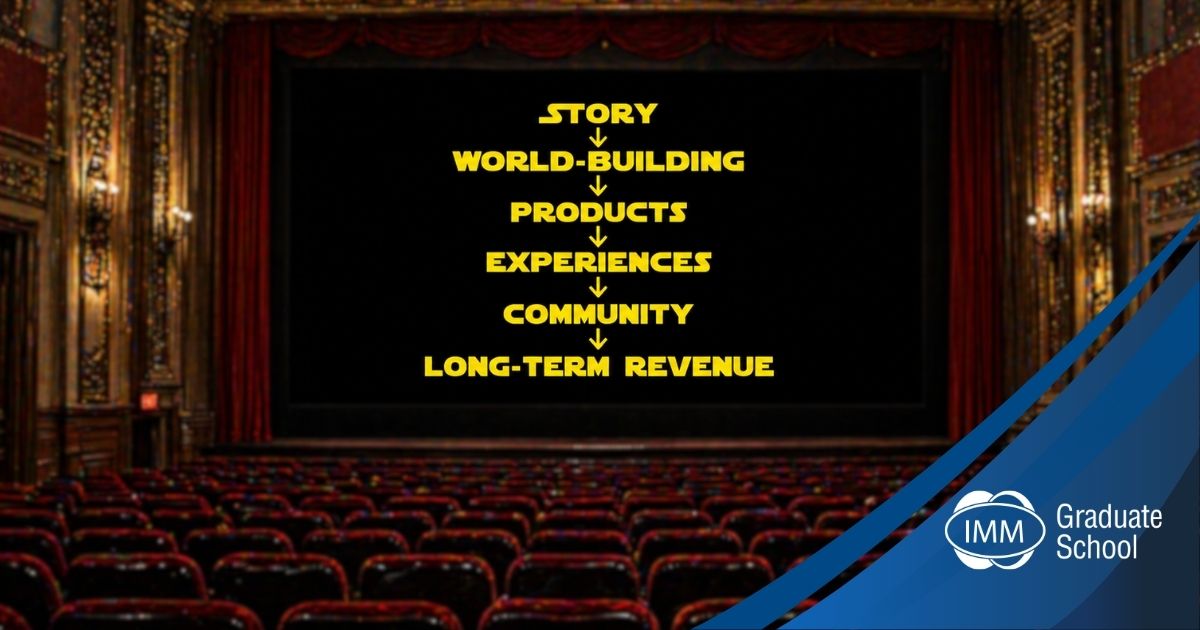
The film is not the product. It is the entry point into a wider ecosystem:
Story → World-building → Products → Experiences → Community → Long-term revenue
Through merchandise and storytelling extensions, Lucas enabled audiences to extend the experience beyond the screen (National Air and Space Museum). A toy became participation in the narrative, not just consumption of it.
Disney’s 2012 acquisition of Lucasfilm formalised this logic at scale, focusing on full intellectual property integration and ecosystem control (StarWars.com).
How Transmedia Turned Fans Into Residents
Star Wars became a benchmark for transmedia strategy, where each platform or channel serves a defined role in the marketing ecosystem:
- Films introduce the core narrative
- Series expand timelines and characters
- Games enable interaction within the world
- Books and comics deepen lore
- Theme parks create immersion
- Merchandise extends ownership into daily life
Disney’s Galaxy’s Edge demonstrates this shift most clearly, placing visitors inside the story environment rather than outside it (Wharton).
The lesson is not channel expansion. It is role clarity across a unified world.
The Brand Moment the Brand Did Not Create
May the 4th began as a fan-driven pun on “May the Force be with you” before becoming an official global marketing moment.
Disney did not invent it. It amplified it.
This is a rare but important marketing dynamic: enabling fan-led creation rather than manufacturing every brand moment internally (Filmustage). One AR retail activation extended this idea into physical and digital spaces across more than 20,000 locations (Marketing Dive).
The insight is simple. Observe where attention already exists, then support it.
What Star Wars Got Wrong
Not all outcomes were successful.
The prequel era showed that merchandise demand cannot compensate for weak narrative connection. When audience engagement drops, even strong ecosystems weaken.
Later, Disney’s rapid release strategy created fatigue. Multiple films and series reduced the sense of cultural “event” around each release. Solo underperformed in 2018 partly due to timing and audience saturation.
Scarcity, it turns out, is part of value creation. Disney has since adjusted its approach, spacing releases and focusing on depth over volume (Wharton).

The Real Question for Marketers
Star Wars is not a template you can copy. You cannot replicate its origin conditions or cultural timing.
The real lesson is structural:
- Think in long-term asset value, not short-term return
- Design systems that extend participation
- Allow audiences to shape meaning over time
Star Wars is a case study in how brand ecosystems grow, evolve, and sometimes strain under their own scale.
So the question becomes: is your strategy built for immediate performance, or lasting relevance?
The Study of Marketing at the IMM Graduate School
This is the kind of thinking embedded in marketing education at the IMM Graduate School, where real-world case studies are used to connect theory with applied strategy.
The force behind Star Wars was not a single decision, but a series of strategic choices that compounded over time.
Frequently Asked Questions: Star Wars Marketing Strategy & Brand Building
1. How did George Lucas revolutionise entertainment marketing with the original Star Wars franchise?
George Lucas revolutionised entertainment marketing by prioritising intellectual property and merchandising rights over a traditional director’s fee. In 1976, movie tie-ins were merely an afterthought, but Lucas recognised that the fictional universe would outlast its initial cinema run. This historic decision shifted the traditional business model, proving that a film could serve as the entry point into a multi-billion-pound ecosystem where consumer products drive the dominant share of total revenue.
2. What is a transmedia marketing strategy and how does it drive long-term brand equity?
A transmedia marketing strategy involves distributing unique pieces of a cohesive narrative across multiple media platforms, where each channel serves a distinct role within the wider brand ecosystem. Instead of merely duplicating content, films introduce the core plot, streaming series expand character lore, games enable interactive participation, and immersive theme parks extend ownership into daily life. This structural clarity turns casual consumers into active participants within a unified brand universe.
3. Why did Disney’s rapid film release strategy lead to market saturation and brand fatigue?
Disney’s rapid release strategy after acquiring Lucasfilm led to brand fatigue because over-saturating the marketplace reduced the sense of cultural novelty surrounding each individual launch. The underperformance of specific films proved that robust merchandising networks cannot compensate for a weakened narrative connection or audience exhaustion. Consequently, modern brand managers recognise that artificial scarcity and strategic spacing are critical components of maintaining consumer value.
4. How does the IMM Graduate School use iconic case studies like Star Wars in its marketing curriculum?
The IMM Graduate School embeds high-impact, real-world case studies like Star Wars directly into its marketing curriculum to bridge the gap between abstract academic theory and applied corporate strategy. By deconstructing the commercial successes and operational missteps of global franchises, students learn to analyse intellectual property integration, consumer culture, and ecosystem design, ensuring they develop the technical judgement required for modern brand management.
5. Which qualifications at the IMM Graduate School focus on long-term brand strategy and ecosystem thinking?
Long-term brand strategy and consumer ecosystem design are core focus areas across several specialized programmes at the IMM Graduate School. These concepts are introduced fundamentally in the Bachelor of Business Administration (BBA) in Marketing Management, and are explored with greater strategic depth in postgraduate programmes such as the BPhil Honours in Marketing Management and the Master of Philosophy (MPhil) in Marketing.
6. How does the IMM Graduate School prepare digital marketers to capitalise on fan-led brand movements?
The IMM Graduate School prepares digital marketing students to identify, monitor, and responsibly amplify organic consumer attention rather than trying to manufacture every brand moment internally. Through modules focusing on digital strategy, public relations, and relationship marketing, students learn how to foster community engagement, manage user-generated content platforms, and coordinate large-scale augmented reality (AR) retail activations.